Masaaki Hasegawa (1987) is a multidisciplinary artist and author based in Spain. His practice investigates painting as a process of embodied perception shaped by temporality, material transformation, and sensory experience.
Working through abstraction and ritualized gesture, he explores how shifting psychological, bodily, and environmental conditions become embedded within physical action and material surfaces. Flowers occupy a central role — functioning simultaneously as tools, perceptual interfaces, and material agents that alter bodily movement, pressure, rhythm, and sensory feedback within the act of painting.
Influenced by long-term engagement with martial arts, underground culture, analytical disciplines, and collaborations with scientific and technical fields, his work operates between painting, performance, and perceptual inquiry.
Hasegawa has realized large-scale projects and exhibited internationally across Europe, the Middle East, and Asia, including a 1,926-square-meter site-specific work in Madrid.
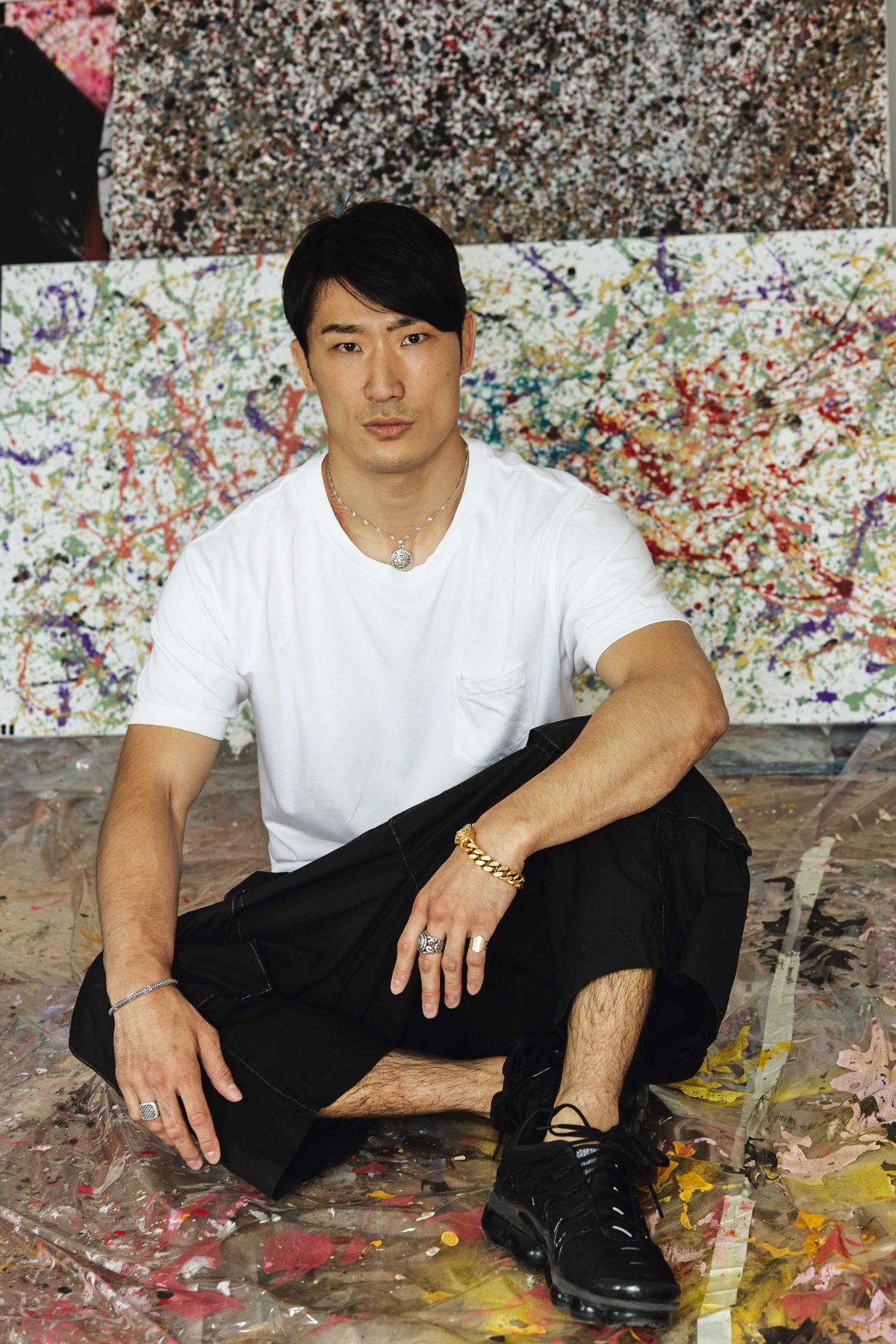
My practice approaches painting as an embodied and ritualized process through which perception, bodily awareness, movement, and material transformation continuously interact. Rather than beginning from predetermined images, the work emerges through fluctuating psychological, sensory, and environmental conditions experienced in real time.
I am interested in how transient internal states — tension, obsession, instability, concentration, absence, exhaustion, or sensory overload — become physically embedded within gesture, repetition, and material surfaces. Painting functions not as representation, but as a temporal condition in which cognition, bodily action, and material behavior briefly converge.
I do not approach painting as the production of autonomous images, but as the residual trace of an event — a temporary convergence between body, cognition, sensation, environment, and material process. Impermanence is therefore not treated as a theme alone, but as a structural condition underlying perception, memory, and existence itself.